Introduction
In the past few years, India’s grocery and convenience retail market has undergone a structural shift. Urban consumers increasingly expect everyday essentials to arrive at their doorstep within minutes rather than hours or days. At the center of this transformation stands Zepto, a startup that built its identity around the promise of ultra fast delivery.
Founded by young entrepreneurs Aadit Palicha and Kaivalya Vohra, Zepto emerged as one of the fastest growing startups in India’s quick commerce ecosystem. By combining a hyperlocal supply chain, technology driven operations, and data optimized inventory management, the company created a new category of retail experience.
This case study explores Zepto’s business model, growth strategy, operational mechanics, and the structural challenges that shape its future.
The Market Opportunity: Rise of Quick Commerce
Urban lifestyles in India have been evolving rapidly. Busy professionals, dense cities, and rising digital adoption have fueled demand for faster delivery of everyday essentials. Traditional ecommerce models, which typically promise delivery within one or two days, fail to satisfy urgent needs such as groceries, snacks, medicines, or household supplies.
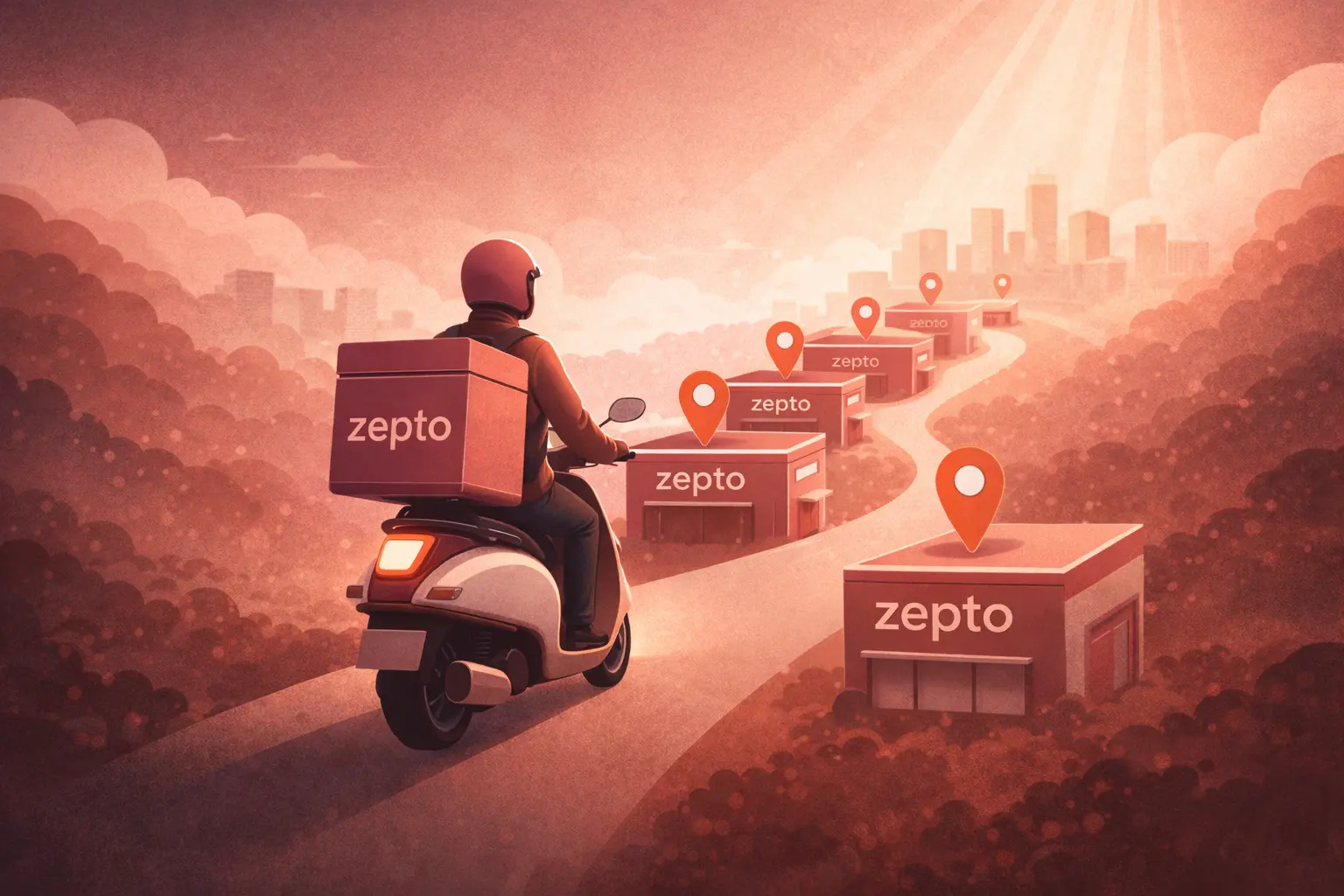
Quick commerce platforms aim to solve this problem by delivering products within minutes. Instead of relying on large centralized warehouses, these companies operate small hyperlocal fulfillment hubs known as dark stores.
According to the document’s explanation of Zepto’s business model, the quick commerce model revolves around speed, proximity, and high frequency consumption categories. These dark stores are strategically placed inside dense urban neighborhoods so that delivery partners can reach customers in extremely short time windows.
This operational structure allows Zepto to promise deliveries in around ten minutes in many locations.
The Zepto Business Model
Zepto’s business model integrates technology, logistics, and retail inventory into a tightly optimized ecosystem.
Dark Store Network
The backbone of Zepto’s operations is its dark store network. These facilities function as micro warehouses located close to customer clusters. Each dark store typically serves a small delivery radius to maintain extremely short delivery times.
The visual diagrams in the document show how dark stores sit at the center of Zepto’s logistics system, enabling rapid picking, packing, and dispatching of orders.
Because these stores carry only fast moving products, inventory turnover is significantly higher than traditional retail outlets.
Product Assortment Strategy
Unlike large ecommerce marketplaces that offer millions of products, Zepto focuses on a carefully curated catalog of high demand everyday items. This includes groceries, dairy products, snacks, beverages, fruits, vegetables, and basic household supplies.
Limiting the number of products simplifies inventory management and reduces picking time inside dark stores.
Technology and Data Optimization
Zepto relies heavily on data driven decision making. Algorithms analyze order patterns, local demand trends, and inventory performance to determine what products should be stocked at each dark store.
This predictive inventory system ensures that frequently purchased items remain available while minimizing stockouts.
Customer Experience Strategy
Speed alone does not guarantee customer loyalty. Zepto’s growth strategy focuses on delivering a frictionless and reliable user experience.
Ultra Fast Delivery
The company’s core promise revolves around ten minute delivery. Achieving this requires precise coordination between inventory availability, warehouse operations, and delivery routing.
Orders are picked and packed in seconds before being assigned to delivery partners waiting nearby.
User Interface and Product Discovery
The Zepto app is designed for simplicity. Customers can quickly browse curated product categories and reorder frequently purchased items with minimal effort.
The document also highlights how interface design plays a crucial role in guiding customer behavior toward repeat purchases.
High Frequency Purchase Model
Unlike traditional ecommerce purchases that occur occasionally, quick commerce platforms rely on high frequency transactions. Consumers may order multiple times a week for small baskets.
This frequent engagement helps Zepto increase customer lifetime value.
Revenue Model
Zepto generates revenue through multiple channels within its ecosystem.
- Product Margin The company earns margins on products sold through the platform, particularly on private label and high margin items.
- Delivery Fees Small delivery charges contribute to revenue while helping offset logistics costs.
- Platform Advertising Brands pay for visibility within the Zepto app through sponsored placements and promotional campaigns.
- Private Label Products The company has also launched its own brands to increase margins and differentiate its catalog.
Growth Strategy
Zepto’s growth has been fueled by a combination of aggressive expansion and operational optimization.
Dense Urban Expansion
Instead of expanding across many small towns simultaneously, the company initially focused on large metropolitan cities with high population density.
This allowed Zepto to achieve higher order volumes per dark store, improving operational efficiency.
Supply Chain Control
The document emphasizes the importance of owning key parts of the supply chain rather than relying entirely on third party logistics providers.
This approach allows Zepto to maintain tight control over delivery speed and service quality.
Network Effects
As order volume increases in a particular neighborhood, dark store utilization improves. Higher utilization leads to lower operational costs per order.
This creates a positive feedback loop that strengthens the company’s competitive advantage.
Key Challenges
Despite rapid growth, Zepto faces several structural challenges.
Profitability Pressure
Quick commerce requires significant investment in logistics infrastructure, delivery partners, and inventory management. Maintaining profitability while offering ultra fast delivery remains a key challenge.
Intense Competition
The quick commerce market in India includes strong competitors such as Blinkit, Swiggy Instamart, and BigBasket.
Each competitor is aggressively expanding dark store networks and improving delivery speeds.
Operational Complexity
Managing thousands of products across hundreds of micro warehouses requires highly efficient logistics and inventory planning systems.
Any disruption in supply chains can directly affect customer satisfaction.
Conclusion
Zepto represents a new generation of consumer startups that combine technology, logistics, and retail into a tightly integrated system. By building a dense network of dark stores and focusing on speed as a core differentiator, the company has helped define the quick commerce category in India.
However, the long term success of Zepto will depend on balancing growth with sustainable economics. As competition intensifies and customer expectations continue to rise, the company must continuously refine its operations, strengthen its supply chain, and maintain superior customer experience.
If it succeeds, Zepto could redefine how urban consumers access everyday essentials, transforming grocery shopping into an on demand service delivered within minutes.
Leave a Reply