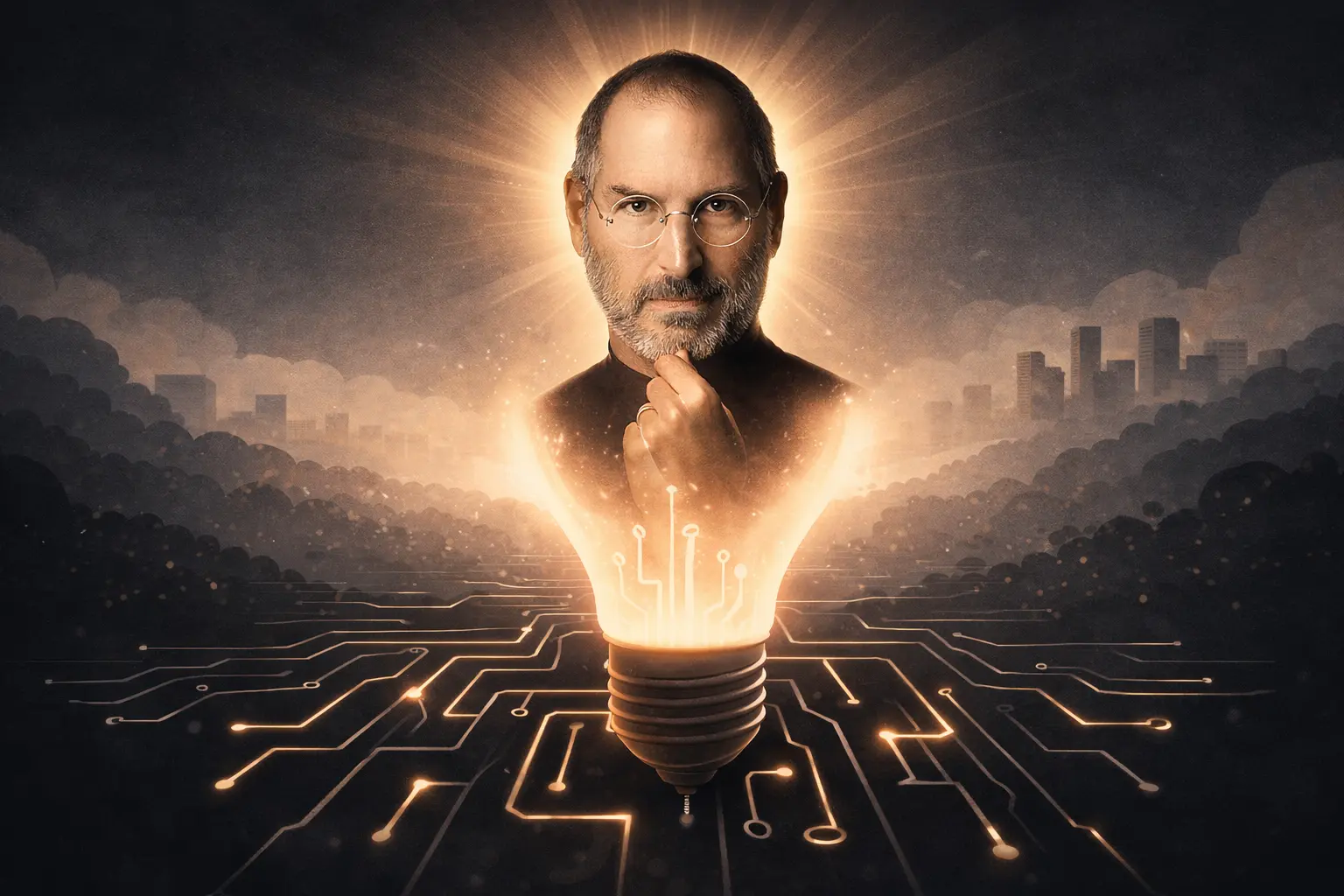
Few business leaders have shaped modern technology as profoundly as Steve Jobs. Long before smartphones became extensions of human identity or digital ecosystems redefined everyday life, Jobs was already imagining a future where technology would feel personal, intuitive, and almost invisible.
What made Jobs extraordinary was not only his ability to see the future but also his uncanny skill in convincing others to believe in that future. Engineers, designers, investors, and consumers often followed him into ideas that initially seemed unrealistic.
The result was a series of products that did not simply improve existing technologies but fundamentally changed how people interacted with machines.
Table of Contents
- Seeing the Future Before Everyone Else
- The Persuasion Power That Built Revolutionary Products
- Why Jobs’ Vision Still Shapes Technology Today
Seeing the Future Before Everyone Else
Steve Jobs possessed a rare ability to anticipate shifts in technology years before they became mainstream.
When he returned to Apple in the late 1990s, the company was struggling. Personal computers were largely utilitarian devices designed around engineering logic rather than human experience.
Jobs believed the future of computing would revolve around simplicity, design, and emotional connection.
This philosophy produced the iMac in 1998, a colorful and user friendly machine that reimagined what a personal computer could look like. It was not merely a product launch but a statement about how technology should feel.
The same forward thinking guided the creation of the iPod in 2001. At the time, digital music players existed, yet none had transformed the music experience. Jobs envisioned a seamless ecosystem connecting hardware, software, and digital distribution.
Years later, the iPhone would redefine the mobile phone industry entirely by merging communication, computing, and entertainment into a single device.
These products were not simply technological upgrades. They represented a future that Jobs had imagined long before the world was ready for it.
The Persuasion Power That Built Revolutionary Products
Vision alone rarely changes industries. Execution and persuasion are equally essential.
Steve Jobs was famous for what many colleagues called his reality distortion field. Through relentless storytelling and conviction, he could persuade teams to attempt what initially seemed impossible.
Engineers often described entering meetings convinced a project could not be done, only to leave believing it was achievable.
Jobs’ approach combined three elements. First, he simplified complex ideas into compelling narratives about how technology could improve everyday life. Second, he demanded extreme attention to detail, pushing teams to refine products until they met his exacting standards. Third, he communicated the broader purpose behind every product.
This ability to align vision with execution helped Apple transform entire industries including music, smartphones, animation, and personal computing.
Even his work beyond Apple showed the same foresight. At Pixar, Jobs helped nurture a studio that would redefine digital animation and storytelling.
Why Jobs’ Vision Still Shapes Technology Today
More than a decade after his passing, Steve Jobs’ influence remains deeply embedded in the technology world.
Many of the concepts he championed have become industry standards. The idea that technology should prioritize user experience, minimal design, and seamless ecosystems now defines modern product development.
Companies across Silicon Valley continue to emulate Apple’s integrated approach where hardware, software, and services work together as a unified experience.
Perhaps Jobs’ greatest legacy lies in demonstrating that breakthrough innovation often requires thinking far beyond immediate market demands.
Consumers rarely ask for products that do not yet exist. Visionary leaders must imagine possibilities before they become obvious.
Steve Jobs did precisely that. By seeing years ahead and persuading others to believe in the same future, he transformed ideas into realities that reshaped everyday life.
The magic behind his success was not only creativity or technical insight. It was the rare ability to combine imagination, conviction, and execution into a vision that the world eventually followed.