Table of Contents
- The Numbers Behind the Migration
- Capital, Compute and Market Access
- What This Trend Means for India
The Numbers Behind the Migration
The movement of Indian AI founders to the United States is no longer speculative. It is measurable.
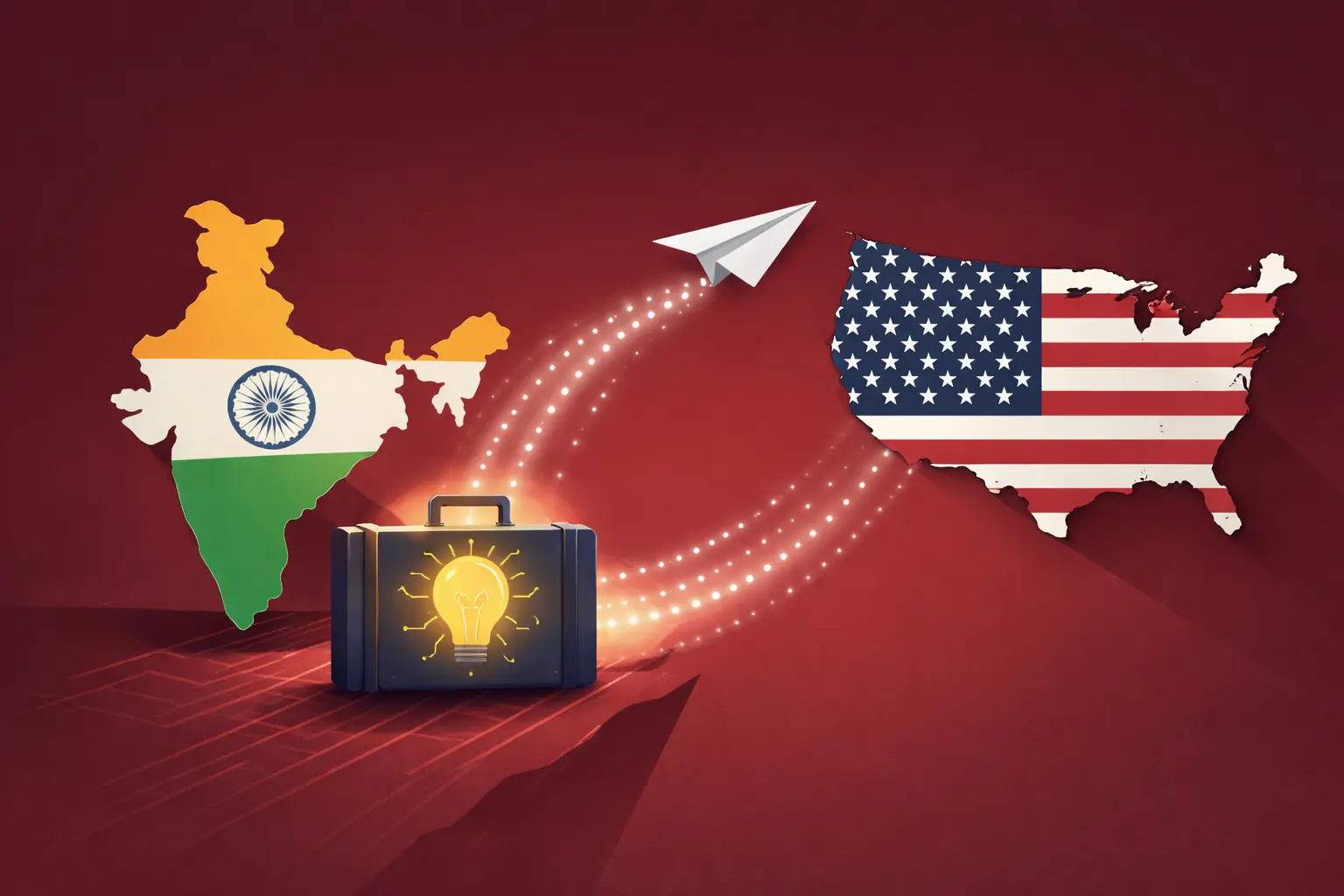
More than 100 Indian AI startup founders have either relocated to the United States or are in the process of shifting their base, particularly to California. This shift has accelerated over the past three years as generative AI and foundational models attracted record levels of funding.
In 2024 alone, AI startups in the United States attracted over 60 billion dollars in venture funding. By comparison, total AI focused startup funding in India remained below 1.5 billion dollars during the same period. The gap is not incremental. It is structural.
Another data point highlights the imbalance. Around 40 percent of startups in the United States AI ecosystem are engaged in training data, model infrastructure or foundational AI research. In India, only about 2 percent of startups are working in these core layers. The majority operate at the application layer.
Immigrant founders play a dominant role in American AI companies. A significant proportion of leading AI startups in the United States have at least one immigrant founder, and Indian origin entrepreneurs form one of the largest segments within that group. In Silicon Valley alone, Indians account for roughly 8 percent of startup founders despite representing a much smaller share of the overall population.
The migration is therefore not accidental. It reflects capital density, ecosystem maturity and infrastructure concentration.
Capital, Compute and Market Access
Artificial intelligence is a capital intensive industry. Training large language models can cost tens of millions of dollars in computing expenses. Access to advanced GPUs, data centers and high performance clusters is far more concentrated in the United States.
Enterprise adoption data reinforces this dynamic. The United States accounts for the largest share of enterprise AI spending globally, driven by sectors such as healthcare, finance, defense and technology. Early enterprise contracts often determine whether AI startups survive their first two years.
Indian AI founders also report that average early stage funding rounds in the United States are significantly larger than comparable rounds in India. Seed rounds in the U.S. AI ecosystem frequently cross 5 to 10 million dollars, while Indian seed rounds for AI infrastructure startups tend to be much smaller.
The talent factor is equally important. The United States hosts a dense concentration of AI researchers affiliated with leading universities and research labs. Proximity to this ecosystem accelerates hiring, partnerships and credibility.
Founders often maintain engineering teams in India while shifting headquarters, fundraising operations and go to market teams to the United States. This hybrid model reflects economic logic rather than emotional choice.
What This Trend Means for India
The relocation of AI founders signals both ambition and constraint.
On one side, Indian entrepreneurs are competing at the highest level of global technology. On the other, foundational AI companies are choosing to incorporate and scale in another geography.
India remains one of the largest talent pools for software engineering. It produces hundreds of thousands of engineers annually and has one of the fastest growing digital user bases in the world. Yet deep tech capital, large scale compute infrastructure and late stage AI funding remain limited compared to the United States.
If this pattern continues, India risks becoming primarily an application and services layer in the AI economy rather than a core model builder.
However, the story is not entirely one of loss. Many Indian founders abroad retain strong operational ties to India, including R and D centers and engineering hubs. Cross border capital flows and technology transfer remain active.
The data shows a clear pattern. Capital concentration, infrastructure access and enterprise demand are pulling Indian AI founders toward the United States. Whether India can rebalance this equation will determine its long term position in the global artificial intelligence landscape.