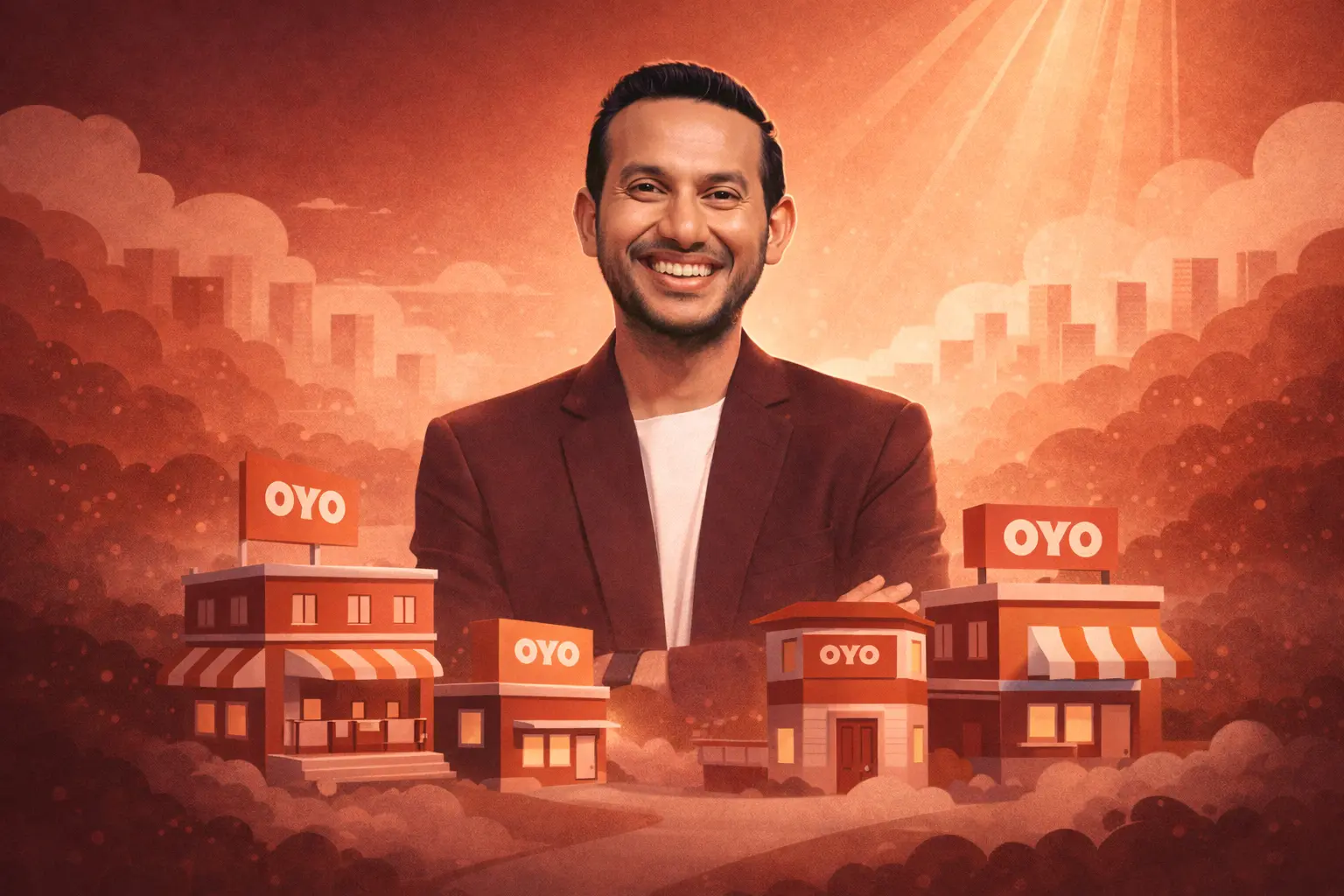
Few entrepreneurs in India have scaled a startup as rapidly and audaciously as Ritesh Agarwal. Starting as a teenage founder with a bold idea about affordable travel, Agarwal built OYO into one of the world’s most recognized budget hospitality platforms.
From small guest houses in India to hotels across dozens of countries, OYO’s journey has been defined by explosive growth, intense challenges, and continuous reinvention.
What began as an experiment to standardize budget accommodations eventually evolved into a global hospitality network powered by technology and partnerships.
Table of Contents
- The Early Vision Behind OYO
- The Rapid Expansion That Disrupted Hospitality
- Reinvention and the Road Ahead for OYO
The Early Vision Behind OYO
Ritesh Agarwal’s journey into entrepreneurship began unusually early. Born in Odisha, he developed a fascination with business and travel during his teenage years.
While traveling across India, Agarwal noticed a persistent gap in the hospitality market. Budget hotels were plentiful, yet the experience was unpredictable. Rooms lacked consistent quality, amenities varied widely, and booking processes were often inefficient.
Agarwal believed technology could solve this problem.
In 2013, he launched OYO with the aim of standardizing budget hotels by partnering with small property owners. Through OYO’s platform, hotels could improve their service standards, upgrade facilities, and gain access to online bookings.
For travelers, the promise was simple. Affordable rooms with predictable quality and seamless digital booking.
The idea resonated quickly, and investors began backing the young entrepreneur’s vision.
The Rapid Expansion That Disrupted Hospitality
OYO’s growth in its early years was nothing short of extraordinary.
By signing up independent hotels and rebranding them under a unified platform, the company created a network effect that rapidly expanded its inventory. The model allowed OYO to scale without owning properties, positioning it as a technology driven hospitality platform rather than a traditional hotel chain.
The company expanded across hundreds of cities in India and soon entered international markets including Southeast Asia, Europe, and the United States.
Major investors such as SoftBank played a critical role in accelerating this global expansion.
At its peak growth phase, OYO became one of the fastest growing hospitality startups in the world. Millions of travelers booked rooms through its app while thousands of hotel owners joined the network to increase occupancy and revenue.
For the hospitality industry, OYO introduced a disruptive model. Technology, data analytics, and dynamic pricing allowed budget hotels to operate with greater efficiency and visibility.
Reinvention and the Road Ahead for OYO
Rapid growth, however, brought its own set of challenges.
As OYO expanded globally, the company faced operational complexities, regulatory scrutiny, and the pressures of maintaining quality across thousands of partner properties.
The COVID 19 pandemic further disrupted the travel industry, forcing the company to rethink its expansion strategy and focus on sustainable operations.
In response, OYO initiated a period of restructuring. The company streamlined operations, improved partner relationships, and focused on profitability rather than pure expansion.
Today, OYO continues to evolve as a hospitality technology platform that serves travelers, hotel owners, and property managers.
Agarwal’s entrepreneurial journey has also become symbolic of India’s startup ecosystem. As one of the youngest self made billionaires in the country, he represents a generation of founders willing to pursue ambitious global visions.
The story of OYO is ultimately about persistence and adaptation. What began as a teenager’s observation about inconsistent hotel rooms grew into a global company that challenged traditional hospitality models.
For Ritesh Agarwal, the mission remains the same as it was at the beginning.
To make quality stays accessible to millions of travelers while empowering small hotel owners to compete in a digital world.