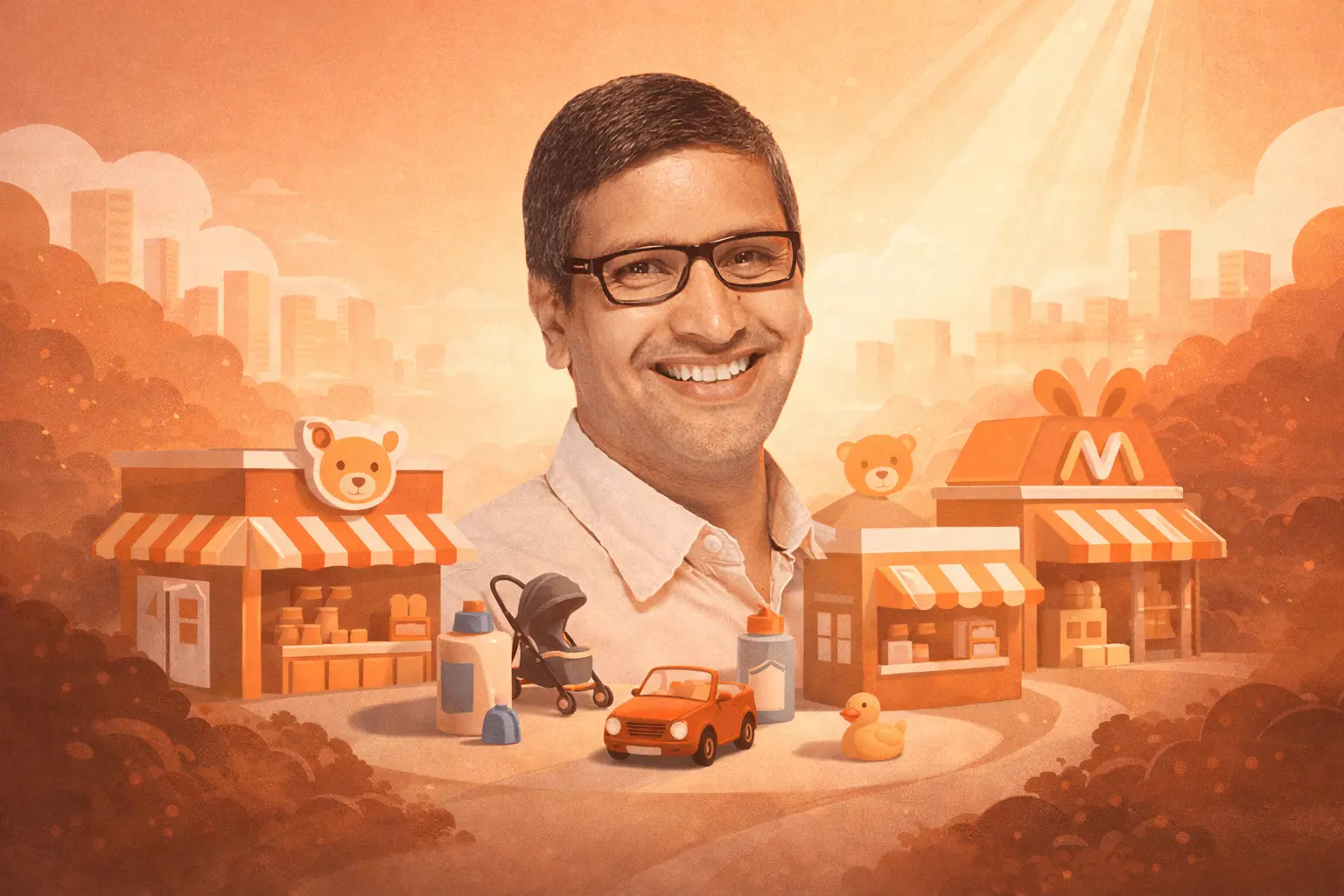
India’s childcare retail market has undergone a dramatic transformation over the past decade. What was once a fragmented and largely unorganized sector has evolved into a fast growing consumer category driven by digital commerce, branded products, and rising parental spending.
At the center of this transformation stands Supam Maheshwari, the founder who built FirstCry into the country’s largest platform for baby and kids products. Through a combination of unconventional strategies, relentless execution, and deep understanding of parents’ needs, Maheshwari has turned FirstCry into a powerful retail ecosystem.
Today the company stands as a defining example of how Indian startups can build category leadership through bold bets and operational discipline.
Table of Contents
- From Startup Idea to India’s Largest Baby Products Platform
- The Contrarian Strategies That Built FirstCry’s Moat
- The Expanding FirstCry Empire and Its Future
From Startup Idea to India’s Largest Baby Products Platform
FirstCry began its journey in 2010 as an online retailer focused on baby and kids products. At the time, the childcare products market in India was massive yet highly fragmented, with most purchases happening through small local retailers.
Maheshwari identified a major gap in the organized retail ecosystem. Parents lacked a single trusted destination where they could find a wide range of products for infants and young children.
The company moved quickly to aggregate demand and supply in the category. Early investments from investors including SAIF Partners, IDG Ventures India, and Valiant Capital Partners helped accelerate the platform’s growth.
Competition intensified as large players entered the market. One of the most significant rivalries emerged with Mom & Me owned by the Mahindra Group.
The competition culminated in a pivotal moment in 2016 when FirstCry acquired the baby care business of Mahindra Retail. The move transformed rivals into partners and solidified FirstCry’s leadership in the category.
The Contrarian Strategies That Built FirstCry’s Moat
Maheshwari’s success was driven by a series of strategic decisions that went against conventional startup thinking.
One of the most important bets was building an omnichannel retail model. While many ecommerce companies focused purely on online operations, FirstCry began opening offline stores through a franchise model as early as 2011.
This approach allowed the company to expand rapidly without heavy capital investment while simultaneously building brand trust among parents.
Another unconventional strategy involved building in house warehouses and logistics infrastructure. At a time when many ecommerce startups relied heavily on third party logistics providers, FirstCry invested in its own operational backbone to improve customer experience and delivery efficiency.
Marketing innovation also played a critical role. Instead of spending heavily on digital advertising, the company launched a hospital gifting program that distributed product hampers to new parents in maternity hospitals.
Over the years, the initiative reached thousands of hospitals and millions of families, creating a powerful emotional connection between the brand and first time parents.
Product variety became another competitive advantage. Today the platform offers more than 18 lakh stock keeping units from thousands of brands across categories.
FirstCry also developed strong private labels such as BabyHug and Cutewalk, which helped the company offer differentiated products while improving margins.
The Expanding FirstCry Empire and Its Future
The growth of FirstCry has mirrored the rapid expansion of India’s childcare products market.
Industry estimates suggest the market could grow from about 31 billion dollars in 2022 to nearly 60 billion dollars by 2027, driven by rising incomes, urbanization, and increasing preference for branded baby products.
FirstCry’s financial performance reflects this momentum. The company’s operating revenue has expanded dramatically in recent years, reaching more than ₹6,480 crore in FY24 compared with about ₹805 crore in FY20.
In 2024, FirstCry reached another milestone when its parent company Brainbees Solutions made its debut on the public markets.
Beyond FirstCry, Maheshwari has built a broader startup ecosystem. He has also been associated with ventures such as XpressBees and GlobalBees, making him one of the rare entrepreneurs behind multiple unicorn companies.
For Maheshwari, the philosophy behind building successful startups remains straightforward. Sustainable businesses are not created through ideas alone but through relentless execution.
As India’s consumer economy expands and young parents increasingly embrace organized retail, the FirstCry empire appears well positioned to remain a dominant force in the country’s childcare market for years to come.