Category: GlobalX

  • Blood and Powder: Inside Mexico’s Cartel War After the Fall of a Kingpin

    Table of Contents

    1. A City Living in Fear
    2. The Business That Fuels the Violence

    A City Living in Fear

    The capture and death of Mexico’s most wanted drug lord, Nemesio Oseguera Cervantes, known as El Mencho, was hailed as a major victory by the government of Mexico. President Claudia Sheinbaum praised special forces for bringing him down. But in the cartel stronghold of Culiacán, the aftermath has brought not peace, but more bloodshed.

    Here, fear has become routine.

    Paramedic Héctor Torres has witnessed the transformation firsthand. Once, he said, the city pulsed with nightlife. Now, silence descends before dark. His ambulance is frequently called to scenes where survival is rare bodies sprawled on sidewalks, inside garages, or beside bicycles.

    The violence stems from fractures within the Sinaloa Cartel, once unified under powerful leaders like Ismael Zambada. His imprisonment in the United States left a vacuum that rival factions are now fighting to fill.

    The consequences are devastating. Paramedics wear heavy body armor, knowing attackers could still be nearby. Soldiers man checkpoints across the city. Even hospitals and funerals are no longer safe.

    Children have become victims. One teenage boy was shot dead while riding his bicycle, his body left in the street as police marked shell casings around him.

    For families, the suffering does not end with death. Many simply disappear.

    Reynalda Pulido has spent years searching for her missing son, digging through fields with other mothers. They probe the earth for hidden graves, driven by hope and grief. “A mother will always look,” she said. “No matter how far.

    The Business That Fuels the Violence

    At the center of this war is fentanyl a synthetic opioid that has become one of the world’s deadliest drugs.

    In a hidden basement, a cartel producer known as Román packed kilogram bricks of white powder destined for American cities. Each package, stamped and sealed, could fetch nearly $30,000 in New York City.

    The trade has become more efficient and more profitable. Instead of pills, traffickers now ship powder, easier to conceal and transport.

    Despite pressure from both governments, production continues uninterrupted.

    Even Donald Trump, who labeled cartels terrorist organizations, has failed to stem the flow. Traffickers insist demand guarantees supply.

    “As long as people want it,” Román said, “it will continue.”

    Meanwhile, ordinary citizens pay the price.

    On one recent evening, Héctor and his partner responded to another shooting. Two men lay bleeding in the street innocent bystanders caught in crossfire. Against the odds, both survived.

    It was the first time in months that Héctor had transported victims who were still alive.

    He removed his gloves, soaked in blood, and lit a cigarette.

    Around him, soldiers stood guard. Above, a helicopter circled.

    And in Culiacán, the war went on.

    Edited By : Aman Yadav
  • Gaza After the “Ceasefire”: Mosab Abu Toha Says the War Has Not Ended

    Table of Contents

    1. A Fragile Pause Amid Ruin
    2. Borders, Belief and the Politics of Return
    3. Washington’s Debate and the Cost of Silence

    A Fragile Pause Amid Ruin

    For Mosab Abu Toha, the Pulitzer Prize-winning Palestinian poet who left Gaza in 2023 after being detained and beaten by Israeli forces, the word “ceasefire” rings hollow.

    In interviews this week, Abu Toha described conditions in Gaza as catastrophic despite a U.S.-brokered truce announced in October. Citing figures from Gaza health officials and humanitarian groups, he said hundreds of Palestinians have been killed since the agreement took effect. “It’s still a genocide,” he said. “Ongoing.”

    A recent study published in The Lancet, the British medical journal, estimated that more than 75,000 Palestinians were killed violently in the first 16 months of Israel’s military campaign a number significantly higher than earlier figures released by Gaza’s Health Ministry. Researchers found that women, children and the elderly accounted for more than half of the deaths.

    Israel disputes accusations of genocide and says it targets Hamas militants while seeking to minimize civilian casualties. The war began after Hamas’s Oct. 7 attack on Israel, which killed about 1,200 people and resulted in the capture of more than 200 hostages, according to Israeli authorities.

    But for residents of Gaza, Abu Toha said, daily life remains defined by displacement and scarcity. He described family members living in tents pitched beside the rubble of their homes. Access to clean water is limited, he said, and food deliveries, though resumed in part, fall far short of what is needed after months of hunger.

    Medical evacuations remain a flashpoint. Palestinian health officials have said that roughly 20,000 patients require urgent treatment outside Gaza, including thousands of cancer patients and children in need of specialized care. Aid organizations have reported that many have died while waiting for permission to cross out of the enclave. Israel has said that security considerations govern exit approvals.

    The Rafah crossing, once Gaza’s primary gateway to Egypt, has become heavily militarized. Abu Toha called it “a checkpoint,” saying that families seeking passage often face prolonged delays and uncertainty.

    Borders, Belief and the Politics of Return

    The war has unfolded alongside intensifying political rhetoric in Washington and Jerusalem. Recently, the U.S. ambassador to Israel, Mike Huckabee, suggested in a televised interview that biblical claims underpin Jewish ties to the land. The remarks drew condemnation from Arab and Muslim leaders and renewed debate over the role of religious language in modern diplomacy.

    Abu Toha responded by invoking his own family history. His grandparents, he said, were expelled from Jaffa in 1948. “They didn’t know about the Bible,” he said. “They were living there.”

    He questioned framing the conflict solely through ancient scripture. “Is there something in the Bible about mercy and justice?” he asked, reflecting on the interview. For Palestinians, he said, the land is not an abstraction but the site of lived memory and identity.

    The idea of transforming Gaza into a modern resort destination a concept floated by former President Donald Trump and his son-in-law Jared Kushner in past remarks about redevelopment struck him as surreal. Reconstruction, he said, cannot precede accountability. He pointed to longstanding United Nations resolutions calling for an end to occupation and adherence to international law.

    Israel’s government has rejected many U.N. resolutions as biased and maintains that its military operations are acts of self-defense.

    Washington’s Debate and the Cost of Silence

    In the United States, the war has reverberated politically. An internal Democratic National Committee review of the 2024 election — portions of which were reported but not publicly released reportedly found that voter dissatisfaction with the Biden administration’s Gaza policy contributed to Vice President Kamala Harris’s defeat.

    Abu Toha, now living in the United States, said he believed American leaders underestimated the political and moral weight of the conflict. Images from Gaza circulated widely on social media, he noted, shaping public opinion beyond traditional party lines.

    For him, the consequences are measured less in electoral outcomes than in lives lost. Thousands remain buried beneath collapsed buildings, according to Palestinian officials. Recovery efforts are slow, hampered by damage and limited equipment.

    “The hugest loss,” he said, “has been to us as Palestinians.”

    As diplomats debate next steps and political leaders trade accusations, residents of Gaza continue to navigate a landscape of ruins — uncertain whether the current lull marks the beginning of peace or merely an intermission in a war that, for many, has not truly paused.

    EDITED BY – Swasti Jain
    { STUDENT OF MANAGEMENT STUDIES AND INTERN AT HOSTELBEE}

    FOLLOW HER:

    https://www.linkedin.com/in/swasti-jain-b194412b6

  • Startup Prints Pitch on Giant Cake, Sends It to VC Firm to Land $5 Million Investment

    Startup Prints Pitch on Giant Cake, Sends It to VC Firm to Land $5 Million Investment

    Table of Contents

    1. The Funding Hustle Gets Creative
    2. The Cake That Doubled as a Pitch Deck
    3. What the “Seed Memo” Included
    4. Internet Reacts: Genius or Gimmick?
    5. The Bigger Picture: Standing Out in Venture Capital

    1. The Funding Hustle Gets Creative

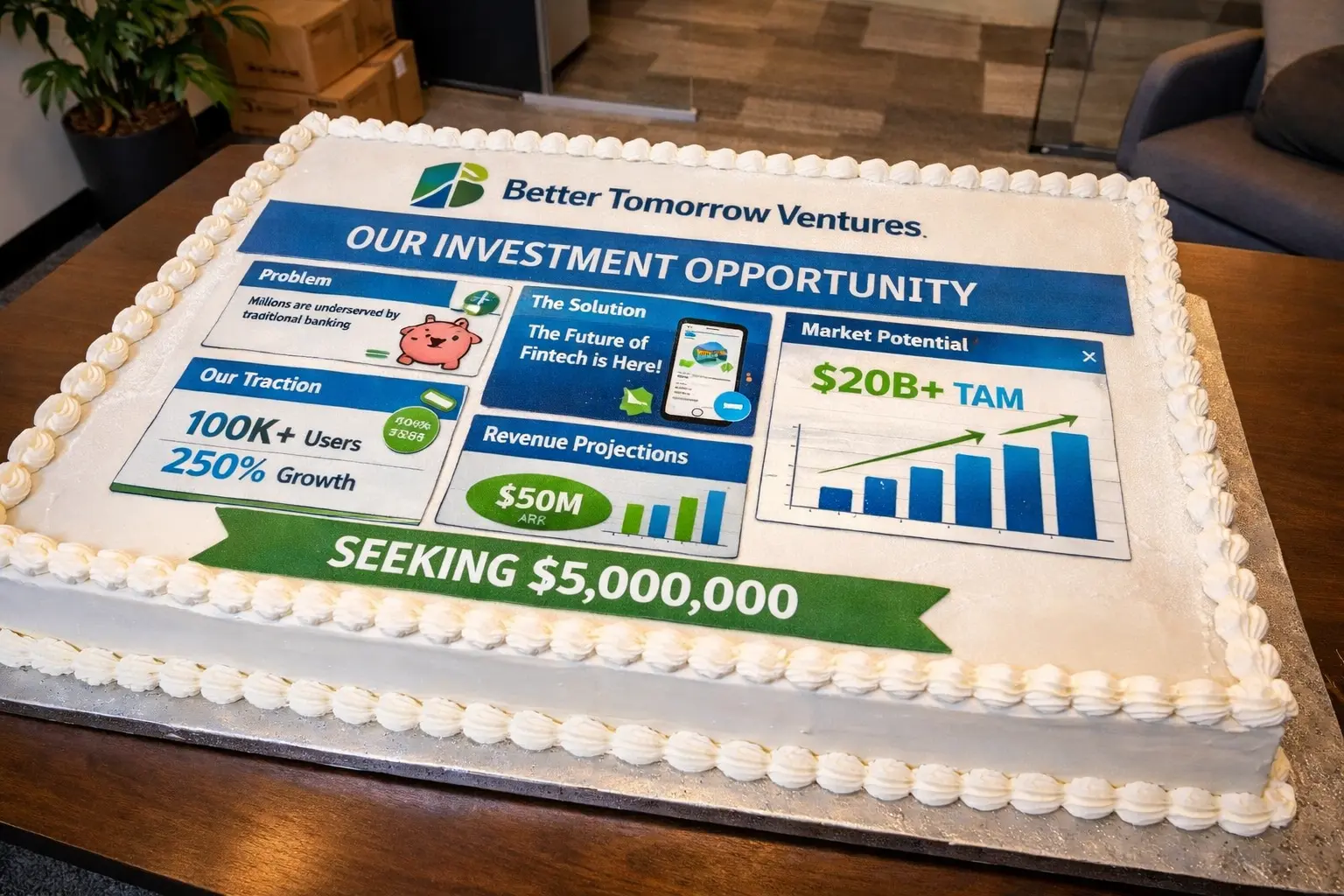
    In the competitive world of startup fundraising, getting a meeting with a venture capital firm often requires bold and unconventional strategies. One startup recently took “thinking outside the box” quite literally by delivering a massive, custom-printed cake featuring its pitch deck to the offices of Better Tomorrow Ventures.

    The fintech-focused early-stage venture firm’s co-founder, Sheel Mohnot, shared a photo of the cake on X, instantly turning the edible pitch into a viral moment.

    2. The Cake That Doubled as a Pitch Deck

    “Someone just came and delivered an absolutely massive cake to our office as a pitch for their company,” Mohnot wrote in his post. “Definitely one way to get attention! Who wants some cake?”

    The image shows a large rectangular sheet cake placed inside a cardboard delivery box. The cake is bordered with light blue frosting dollops and printed across the top with a detailed “Seed Memo.”

    Mohnot later admitted he couldn’t resist taking a slice before snapping the photo.

    “In a world of cold emails and crowded inboxes, one startup chose frosting over formatting.”

    3. What the “Seed Memo” Included

    The edible memo was structured like a traditional investor pitch document and reportedly aimed to raise $5 million in funding.

    Sections on the cake included:

    • What We’re Building
    • Market Opportunity
    • Product Overview
    • Business Model
    • Traction
    • The $5 Million Ask

    It was, in essence, a fully formatted seed memo just printed in icing instead of ink.

    4. Internet Reacts: Genius or Gimmick?

    The stunt sparked mixed reactions online.

    Some praised the founders for their creativity and hustle, calling it a brilliant way to stand out in a sea of pitch decks. Others questioned whether such theatrics risk appearing unprofessional in a high-stakes funding environment.

    In venture capital, where first impressions matter, bold moves can either create memorable differentiation or raise eyebrows.

    “The cake may be sweet — but will the investment be sweeter?”

    5. The Bigger Picture: Standing Out in Venture Capital

    The startup ecosystem is saturated. Investors receive hundreds — sometimes thousands — of cold pitches each year. With inboxes overflowing and meeting slots limited, founders are constantly searching for new ways to break through the noise.

    While it remains unclear whether the cake secured the $5 million investment, it undeniably achieved one objective: attention.

    And in early-stage fundraising, attention is often the first hurdle.

    Whether this edible pitch becomes a case study in creative fundraising or simply a viral anecdote, one thing is certain this startup ensured its pitch wouldn’t be forgotten.

  • The €1 Billion Bet on Gen Z: eBay Buys Depop to Rewire the Future of Resale

    The €1 Billion Bet on Gen Z: eBay Buys Depop to Rewire the Future of Resale

    Table of Contents

    1. A Strategic Return to Youth Commerce
    2. Why Second-Hand Is the New First Choice
    3. The Financial Backdrop: Etsy’s Exit
    4. What This Means for the Resale Economy

    In a decisive move to secure the loyalty of the next generation of consumers, eBay has agreed to acquire second-hand fashion marketplace Depop from Etsy in a $1.2 billion (€1.0 billion) all-cash transaction.

    The deal signals more than just another corporate reshuffle in Silicon Valley. It is a recalibration of eBay’s identity — a return to its roots in peer-to-peer commerce, now reframed for Gen Z’s resale-driven, sustainability-conscious economy.

    As of December 31, 2025, Depop counted 7 million active buyers — nearly 90% under the age of 34 — and more than 3 million active sellers. For eBay, whose growth ambitions increasingly hinge on cultural relevance as much as scale, those numbers represent not just users but future lifetime value.

    Chief Executive Jamie Iannone described the acquisition as a long-term growth lever, positioning Depop to benefit from eBay’s operational infrastructure and global reach. The subtext is clearer: youth commerce is no longer optional — it is existential.

    A Strategic Return to Youth Commerce

    Depop, founded in 2011, built its identity around social discovery and curated resale — closer to Instagram than a traditional marketplace. Its aesthetic, community ethos, and influencer-driven listings attracted young buyers seeking uniqueness over uniformity.

    For eBay, the acquisition reflects both opportunity and necessity.

    The broader resale market has expanded rapidly, driven by rising consumer prices, environmental concerns, and a cultural shift toward vintage and circular fashion. Younger consumers, in particular, are redefining ownership — prioritizing resale, recommerce, and thrifted individuality over fast-fashion churn.

    Five years ago, Etsy acquired Depop for $1.6 billion, betting on similar tailwinds. But the strategic fit proved complex. Etsy’s marketplace centers on handmade and artisan goods; Depop thrived on streetwear drops, Y2K aesthetics, and algorithmic discovery.

    Now, with eBay stepping in, the alignment appears clearer: scale meets subculture.

    The transaction is expected to close in the second quarter and will allow Depop to retain its brand, platform, and cultural independence — a detail that signals eBay’s awareness that authenticity, not integration, is Depop’s core asset.

    Why Second-Hand Is the New First Choice

    The second-hand clothing market is no longer niche. It is structural.

    Consumers increasingly view resale as economically rational and environmentally responsible. With inflation reshaping purchasing behavior across Europe and the United States, used apparel offers price flexibility without sacrificing brand appeal. At the same time, sustainability concerns have pushed circular fashion into the mainstream.

    For Gen Z, resale is not a compromise — it is a lifestyle.

    Depop’s growth underscores that shift. Nearly 90% of its buyers are under 34, making it one of the youngest large-scale marketplaces globally. In an era where digital platforms compete not just for transactions but for cultural relevance, that demographic concentration carries strategic weight.

    Market reaction reflected investor optimism. eBay shares climbed more than 7% in after-hours trading following the announcement, while Etsy shares surged nearly 15%, suggesting shareholders view the sale as capital discipline rather than retreat.

    Etsy said it would use the proceeds for general corporate purposes, share repurchases, and reinvestment in its core marketplace — a move that narrows its strategic focus.

    What This Means for the Resale Economy

    The acquisition consolidates the resale ecosystem at a moment of intensifying competition. Platforms are racing to eliminate seller fees, streamline logistics, and offer buyer protections — all while preserving the peer-to-peer authenticity that attracts younger users.

    For eBay, the deal is both defensive and forward-looking. It protects market share in second-hand commerce while injecting cultural credibility into a brand often associated with earlier internet eras.

    The larger question is whether scale can coexist with subculture. Depop’s value lies in its community-driven energy; eBay’s strength lies in operational muscle.

    If executed carefully, the €1 billion bet may do more than expand a portfolio. It could redefine how legacy marketplaces reinvent themselves in the age of Gen Z wallets — where resale is not a trend, but the architecture of future commerce.